We can’t see what we can’t see. We can’t manage what we can’t see. But these invisible layers seem to be the underlying cause of many recurring management challenges.
When I was writing my next book (to be published in December), I set out to investigate what has been written academically on topics that are sometimes considered esoteric. It turns out that these topics are discussed quite extensively, just using different terminology. And esotericism isn’t something out of this world; it’s simply “internal,” as opposed to “external,” or exoteric.
Those are their words, as they are, but I’m very interested in what it is inside a leader that drives him to make decisions when rational arguments and thoughts run out. What happens when “reason runs out”?
In my work with leaders and management teams, I have noticed that leadership seems to be more of a consequence of a certain reaction than a set of actions in and of itself.
Before any visible decision, conversation, or action, there is always something that drives us toward action—or pushes us away from it. What does a leader actually notice, and what does he or she fail to notice? Why does he or she fail to notice it?
Recurring problems usually do not stem from a lack of skills, but from something deeper. For example, how a leader perceives a situation, what meanings they create, what the leader’s identity entails, and how and what team members “expect from the leader” , what experiences are embedded in their bodies, what drives their reactions, what principles are written on the walls of the team and the organization—not to mention the influences of broader society.
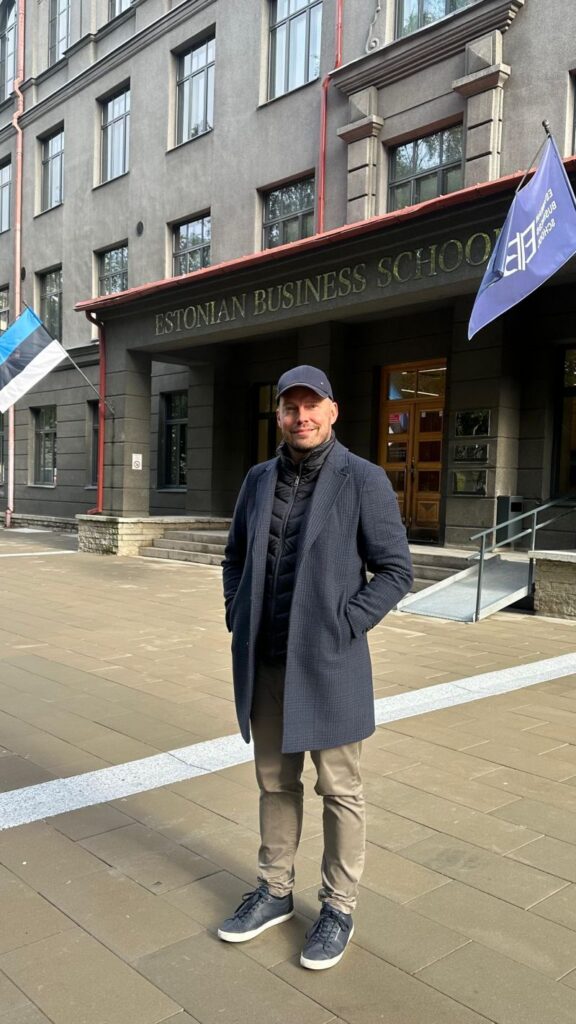
My day-to-day work with teams and writing a book led me quite naturally to academic research, and that, in turn, fueled my interest to such an extent that I am now officially beginning my journey as a doctoral student at EBS to explore all of this and, in a few years, create a framework that will help take management to the next level.
Perhaps it will also offer an opportunity to foster sustained or stable material growth—to harness each person’s creative potential to make the world a better, not a worse, place, and to use business as a means of solving the world’s problems.
In my doctoral dissertation, I explore this in more academic terms by examining how leaders shape understanding in situations where information is incomplete, contradictory, or where the actual problem is not immediately apparent and cannot be solved through reason and analysis alone. Theoretically, I move between topics such as meaning-making, tacit knowledge, embodied knowledge, managerial identity, organizational memory, and systemic dynamics. In plain language, I study the invisible aspects of leadership that often determine highly visible outcomes.
And I’m still continuing my work one-on-one with clients and organizations to ensure that research and practice are combined in such a way that both benefit from each other.
The goal is still to use that same creative energy to build a better world and to ensure that doing business is truly a way to solve the world’s problems, not a way to create them.