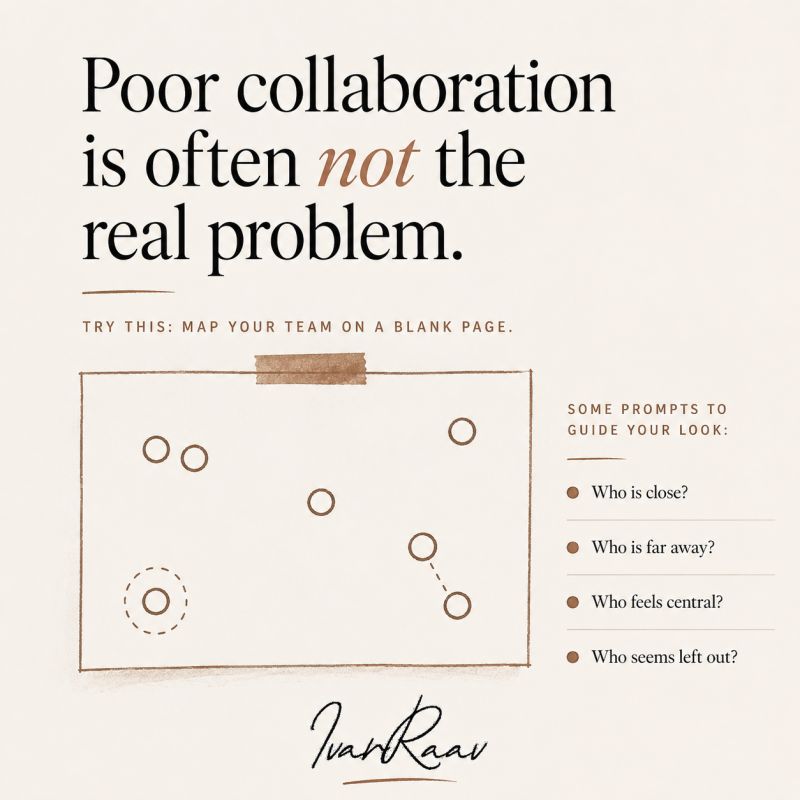
When leaders speak about collaboration problems, they usually describe what is visible on the surface: silos remain, communication feels heavy, things take too long, people attend the same meetings, say the right things, and still something essential does not move.
The longer I have worked with teams and leadership groups, the less I believe that collaboration breaks down on its own. Much more often, what we call a collaboration problem is simply the place where something deeper begins to appear.
For example:
– trust is weaker than people admit
-authority is unclear, so cooperation becomes careful and slightly political
– tension in the leadership team never gets properly named, and the rest of the organization ends up carrying it in the form of friction, slowness, and guardedness
– people look collaborative on the outside, but inwardly they are protecting themselves, their position, or simply their energy
That is why collaboration work can become frustrating when it stays too behavioural. New agreements are made, roles are clarified, workshops are held. And for a while, things may even look better.
But if the emotional and systemic reality underneath remains untouched, the heaviness tends to return, because the roots of it are still alive.
Poor collaboration is often not the core problem. It is the visible expression of something the system has not yet fully faced. One very simple exercise can already make this more visible.
Take an empty sheet of paper and imagine it is your team’s working field. Then place each team member somewhere on that paper. After you have done it, look the paper and ask:
Who is close to whom?
Who is far away?
Who feels central?
Who feels left out?
Who is between others?
Who seems to carry tension?
Who do you place close to yourself?
It is often surprisingly revealing how people position one another and how much that says about the invisible reality of collaboration.