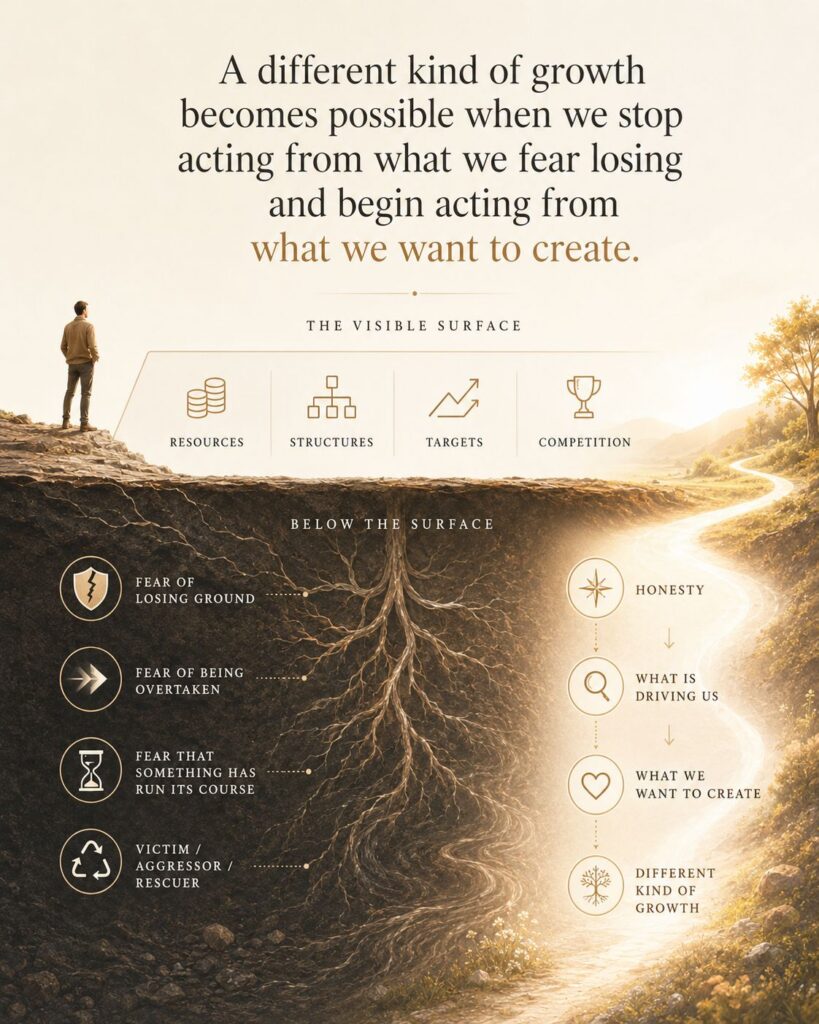
For decades the dominant response to slowing growth has followed the same logic. Redistribute resources differently. Reorganise structures. Set a more ambitious target. Find a competitor to outpace.
The underlying assumption is always that the system is fundamentally sound, and that better tools, better allocation, or better execution will eventually unlock what we are looking for.
But I have watched this pattern long enough in organisations, in leadership teams, in the broader conversations about where economies go next to believe that something more fundamental is being missed.
The deeper issue is not that we are solving the wrong problems. It is that we are solving them from the wrong place inside ourselves.
Much of what drives decision-making at every level (organisational, political, societal) is fear dressed up as strategy. The fear of losing ground. The fear of being overtaken. The fear of admitting that something has run its course. The fear of not being the greatest.
And so we keep moving pieces around the same board, inside the same dynamic of victim and aggressor and rescuer, each role convinced it is the rational one, each solution creating the conditions for the next version of the same problem.
What I believe and what I have seen in the rare moments when something genuinely shifts is that a different kind of growth becomes possible when people stop acting from what they are afraid of losing, and begin acting from what they genuinely want to create.
Not as a motivational idea. But as a practical reorientation of where energy comes from and where it goes.
That kind of shift cannot be engineered from the outside. It begins with honesty about what is actually driving us and the willingness to want something different from that place.