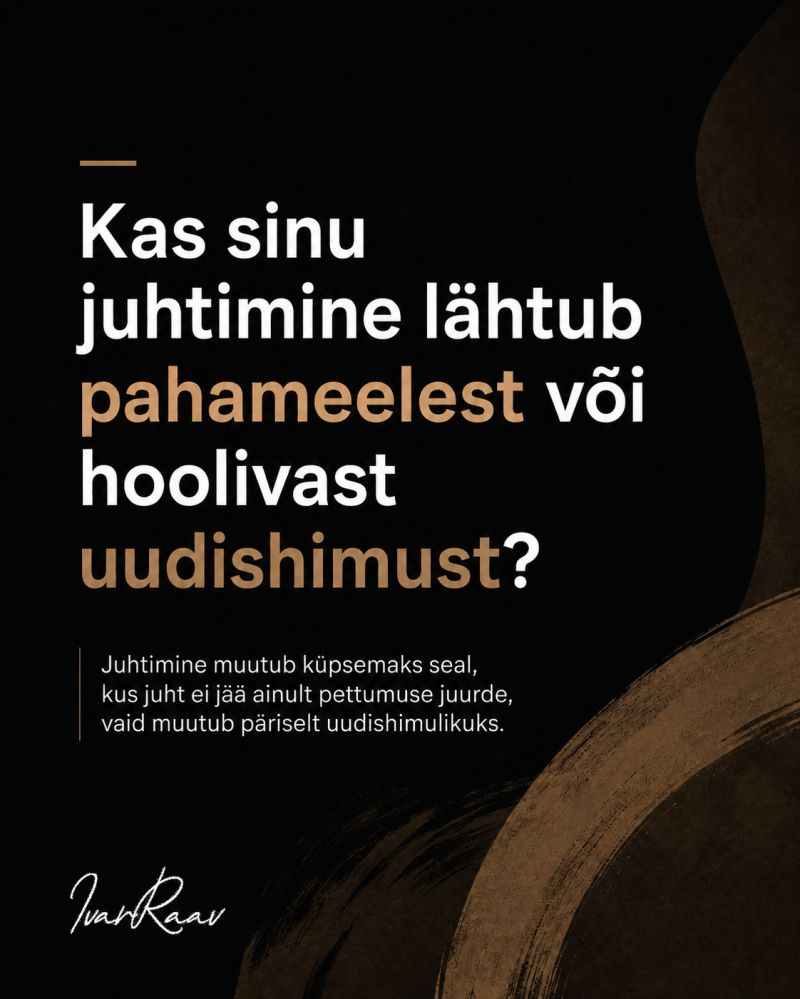
If results are not forthcoming or accountability remains weak, it is very easy for a leader to move from frustration and resentment to internal frustration and resentment and to start to draw on that energy to lead and to deliver messages. And that is human.
Because the driver is under pressure. Something has been entrusted to him. Something has to move. Something has to change. And if that doesn’t happen, the question naturally arises: why don’t they do more, why don’t they take more responsibility, why do I have to do everything myself?
It is very easy from this point to start making decisions to add pressure, to demand more, to become more forceful, to talk about accountability more directly and to push more will into the system. Sometimes it seems to work. But most of the time it only works on the surface and in the short term.
In the long run, the price is often much higher than we can initially see. This cost can be expressed in resentment, internal withdrawal, silent resistance, burn-out and increasingly weakening real contact between people. And because systems are interconnected, it doesn’t just stop at work.
It carries over to home, school, relationships, raising children. When management becomes a fight against its own employees, this logic starts to spread to wider society. Sometimes it feels as if managers are at war with their own employees, with the tools and mentality that come from war.
If a leader is working from an inner frustration or resentment, then underneath it all is a fight against something. And the laws of physics show that force generates counter-force. The more pressure there is in a system, the more caution, internal disengagement, apparent acquiescence, or quiet resistance – or counter-pressure – is created.
That’s why it seems to me more and more that the issue of accountability, for example, doesn’t really move from a place where the manager is only frustrated and wants to fix it quickly.
I believe that change more often starts where a leader is able to stop for a moment and become curious. Not just about why people aren’t doing more, but about what the system is teaching them between the lines every day. And also about what people have learned about responsibility in the first place – whether responsibility means vitality, dignity and influence, or whether it means burden, pressure and threat.
In the end, it also comes down to the question from which position the leader looks at his people: as if they were monarchs fulfilling expectations, or as human beings on the same level.
Perhaps it is worth asking sometimes not only: why don’t they take responsibility? But also: where am I as a leader asking this now – out of resentment or out of caring curiosity?
In my experience, caring curiosity always creates more than hostility, pressure and acceptance in interpersonal relationships. As in domestic relationships, so at work.