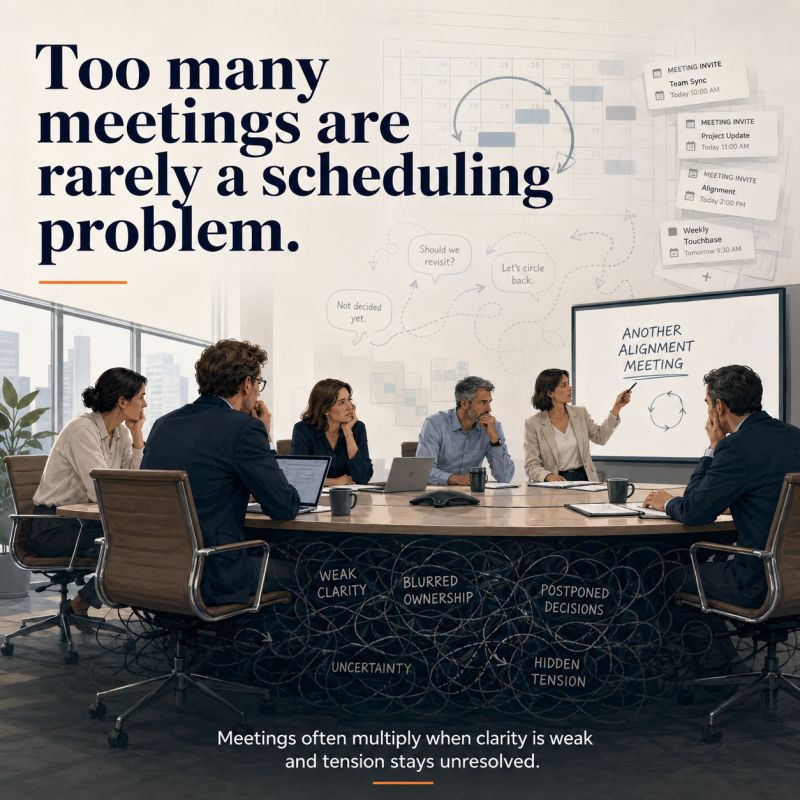
Meeting-heavy cultures are emotionally interesting places to observe. A meeting may look like a practical tool, but very often it is doing invisible work for the system to hide something.
It is holding uncertainty or spreading responsibility more thinly. It is helping people postpone a difficult decision or avoid naming what is actually not working. Sometimes it even gives temporary relief to a leadership team that does not yet know how to carry enough clarity without staying in constant discussion.
People are not necessarily organize meeting because they love meetings. They are meeting because something underneath them is still unresolved and the calendar somehow absorbs what tension in the culture.
So when a team says they need fewer meetings, I find myself becoming curious in a different direction. Not only about efficiency, but about what those meetings are compensating for.
If something is “too much” it is basically always compensation for something else.
Until that becomes visible, the calendar rarely changes for long. It simply reorganizes the same underlying problem into a slightly different weekly rhythm.
Of course there are organizations where people simply have poor habits around meetings, but much more often what I see is something else: meetings begin to multiply when clarity is weak, when ownership is blurred, when decisions do not fully land and when people do not quite trust that things will move forward without one more conversation – to give just some examples of the deeper reasons behind the meetings-heavy culture.