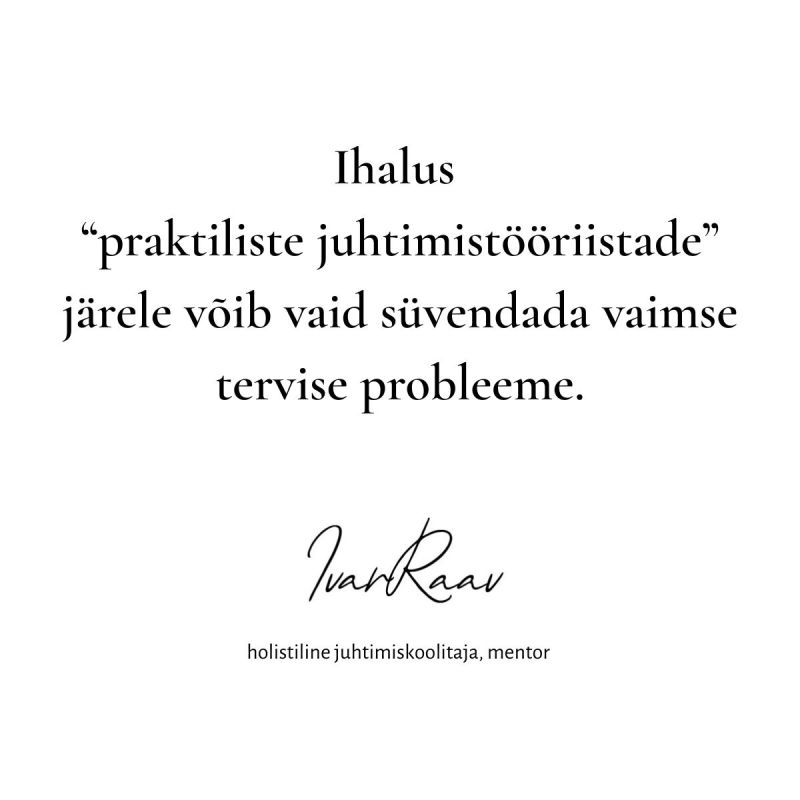
This is something many people have thought or said about managers who come back from management training and start behaving strangely.
People can tell when a manager who’s been trained is going to use some kind of tool on them. People are not machines and managers should not use TOOLS on people.
One of the most common requests I hear from training subscribers is for practical tools. Of course, I understand that this is driven by a desire to see change after a training course. But there’s another angle behind it all. It gets deeper into the mechanical part of human beings. Treating the human as a machine resource for the system has led us to mental health problems.
And it’s not solved with the following tools. Otherwise there would have been no problem if tool-based management had helped.
There is a downside to this desire for “practical tools”, as there is with everything in this world. People are very perceptive when techniques are used on them. They have a manipulative effect.
Tools are designed to correct the mechanical processes of machines. Results that can be measured and optimised, controlled, made efficient. But again, man is not a machine to be put into tools, even though the body- and intellect-centred conception of man assumes him to be man.
Man is broader, more holistic, more holistic – man perceives, feels, senses, opens, trusts, doubts, fears, aches, fears, rejoices, dreams, enjoys. He has a soul and a spirituality that a machine does not have.
Man reacts to man, not to the tool. The leaders of the new era are not using tools, they are making sense of being human, because machines can take over the machine-like today (AI and other technologies we have created), what is left is to make sense of being human, which is especially important to do in the age of AI euphoria.
A person can get on perfectly well with another person if they have learned what it means to be human. The tools may be supportive, but the contact in a human being is still between PEOPLE.
Screening has a much bigger impact than we think. There are connotations in our language that make us think of people as objects to be ‘improved’, ‘managed’, ‘controlled’ or ‘tools to be used’ on.
Words shape culture. Culture shapes leadership. (Self) leadership shapes the person and being human.
To run something, you need to know what you are running. If you’re managing people, it’s important to know what it means to be human. Training is no longer about acquiring “new tips and techniques”, you can ask ChatGPT about that.
The Leadership Training Room is a space for reflection on being human. And it’s gratifying to see that more and more subscribers are looking for this type of environment for ‘training’. Thanks to all those who have confirmed that I am on the right track with my approach to leadership!