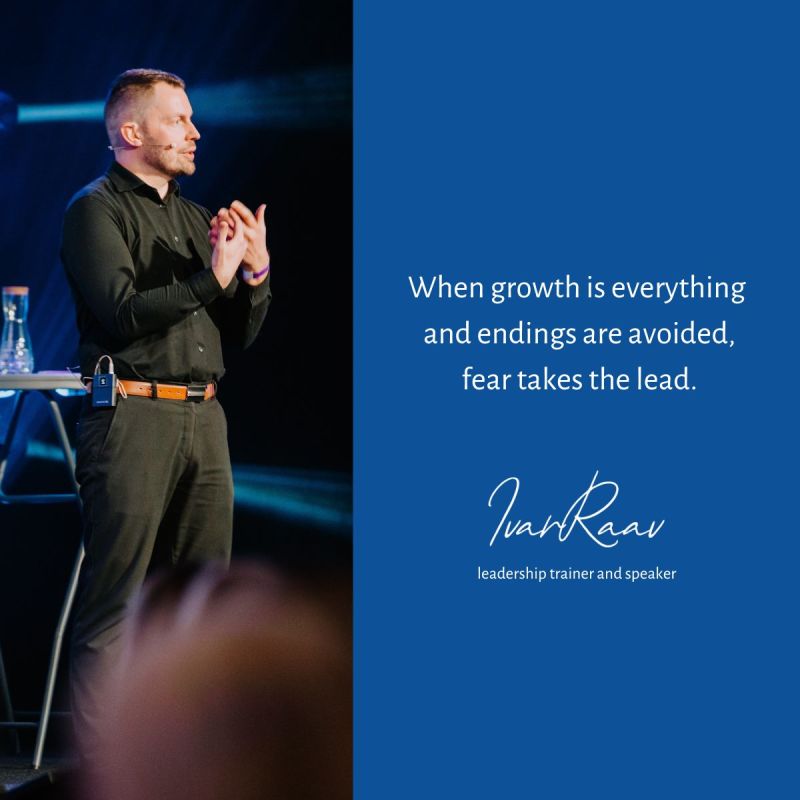
We tend to list them as leadership problems, each needing its own tool and framework. But they are often just different expressions of the same underlying issue: fear.
Underneath strategy slides and KPIs sits a very human question: am I good enough to belong here and through belonging to feel safe and survive?
When that question is activated, survival logic starts driving behavior and leading the human being. People protect territory, avoid risks, hold back, overwork, stay busy. It doesn’t look like fear. It looks like a management challenge.
Our economic system is built on growth, supported by competition. Growth is praised. Holding things steady is sometimes tolerated. Endings are treated as failure.
Yet life moves through three forces: something begins, it is sustained for a while and at some point it ends. Everything in life is influenced by these three:
* the force of creation
* the force of preservation
* the force of destruction
We accept the creative force and celebrate growth. We are much less comfortable with the destructive force like decline, letting go, irrelevance. So we try to eliminate endings from organizational life. And when we push that force away, it shows up elsewhere: burnout, illness, cynicism, anxiety just to name a few.
Fear is natural and necessary for humans. It protects us when there is real physical danger. But in organizations much of the fear is intellectual and identity-based – in many ways illuson. It erodes trust in the system. And when trust weakens, leadership becomes a constant attempt to manage tension.
The calmest (and therefore successful) leaders I have seen are not the ones who try to control everything. They are the ones who understand they are part of something larger, that roles are temporary and that endings are not personal failure but part of the natural flow of life. They don’t pretend they are bigger than life itself. Their spiritual intelligence seems to be higher.
From that place, fear loses some of its power and cooperation becomes possible again instead of competition-driven survival mode, where many organizations and leaders seem to be stuck today.