Those of you who have followed me for a long time will know that I am increasingly questioning practices that have been in place for many years, because of the need to practice. Because the more I see organisations, the clearer it becomes that many of the classic management practices no longer work, even though they are still being trained. Bringing in a new ‘fresh’ trainer doesn’t help if there is a mess in the system itself and we want to fix things with the aim of writing ‘done!’ somewhere.
Things don’t work when people’s connection to their work is increasingly weak, burnout is on the rise, training budgets are increasing, but at the same time we are talking about survival and coping in the results.
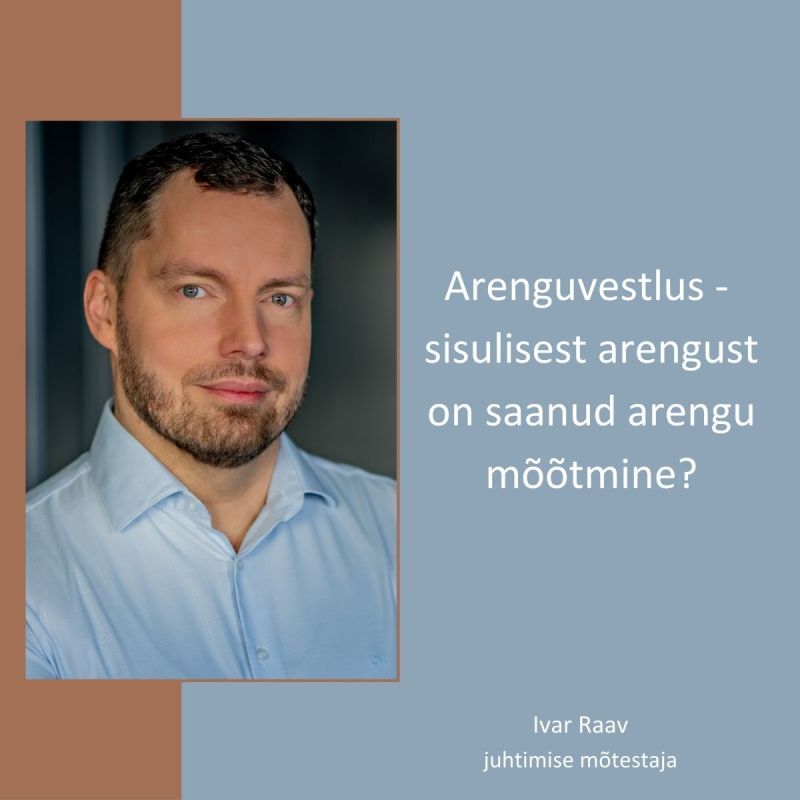
Hence the question: is the development interview a tool for development or another form-filler with a deadline?
A typical situation in many large companies: it’s the start of the year. The HR calendar says that development interviews must be done by a fixed date. The manager feels under pressure. Employee feels pressure. HR feels the pressure. Everyone is “developing”.
A trainer will be hired to teach “how to do a development interview the right way”:
expectations, needs, reflection, active listening, the right questions, and other classics.
All parties are preparing to “respond in the right way”. And then we call it development. Inevitably, the question arises: why do we need a separate development discussion at all, when there is actually a regular, honest and meaningful conversation between people in the organisation?
The original idea of the progress review was not to tick a box on a spreadsheet for bonuses or measurements, an ex-post evaluation of the past year, a dialogue on what is being done ‘right’ using the right techniques.
Its original purpose was to create a safe space between two people to talk about direction, burden, meaning and growth as PEOPLE.
But as often happens with the very best things in the machine world – they become obtuse techniques, mechanical, cranked up into a solemnity, and lose their human warmth.
If this space exists in day-to-day management, the development interview is not a separate event. It’s just another conversation where you technically have to feed the bureaucratic machine with a form filler, but it’s no more than just a conversation.
Unless this deep HUMAN space of warmth is there every day, one structured meeting once or twice a year will not create it. A paradox emerges: the more an organisation relies on formal development meetings
the greater the likelihood that there is no regular mutual support.
Perhaps we should not be asking how to do development interviews better,
but rather why have we created a management culture where development is concentrated in a single interview?
If managers would dare to talk in more depth more often, to listen without immediately resolving, to spot the person before the result, much of the tension around development interviews would disappear.
And perhaps the need to “do them away” would disappear.
Does the system we have created really support the development of people and the organisation, or just measure it? It seems to me that we measure development more than we experience it and do it.