I was hoping it would go away on its own, but of course it didn’t. I finally made it to the dentist, and it turned out I needed a root canal. Not just pain relief or a quick fix for a surface cavity, but actually going all the way down to the root and cleaning out the whole mess.
The more I observe organizations and management, the more it seems to me that we very often do exactly the same thing—we talk about problems, but we’re actually just treating the symptoms.
Productivity drops, accountability fades, information gets stuck somewhere, motivation wanes, constant change becomes exhausting, people burn out, and so on. Then a new tool is added, a new process, a new metric, new training, a new strategy day. Of course, all with the best of intentions, and naturally, it works quite well up to a point.
I always find these kinds of workshop inquiries very interesting, and I always start wondering what lies behind them on a deeper level—where conventional tools are of no help at all. My detective’s eye kicks in—not to figure out what the exact problem is and which technique, or “practical tool,” to solve it, but the real excitement lies in figuring out what is actually causing the problem and why existing tools haven’t solved it. People generally have knowledge of management tools, so that’s usually not the issue, although it’s often assumed that this helps. It only helps to about 70%. Every management technique, style, and method has its own limitations.
Because maybe the organization isn’t broken in a way that needs to be fixed with strategic management techniques? Maybe the pain has simply been suppressed for so long that the real cause has remained unaddressed. These are always the most exciting projects for me—the ones where the client says right from the start that there’s something we can’t quite put our finger on, but we realize that it’s actually guiding us in some way without us even realizing it.
It seems to me that one of the biggest pitfalls of modern management is that we focus on what is visible, easily influenced, and measurable—in other words, what is practical.
And we avoid what is slower, more uncomfortable, internal, and harder to put into words—yet still exists and can be felt through our gut or intuition.
But that is precisely what is actually driving you and causing you pain. So I still urge you to ask yourself what kind of pain you’re currently numbing, instead of really getting to the root of it—no matter how uncomfortable that might be and how much more it might cost at first (in terms of energy, specifically)?
And I’m always excited to take on new projects like this, where I get to explore with the client without either of us knowing exactly where we’ll end up. Generally speaking, we actually get to the root of things when neither of us has a crystal ball telling us what the right way is.
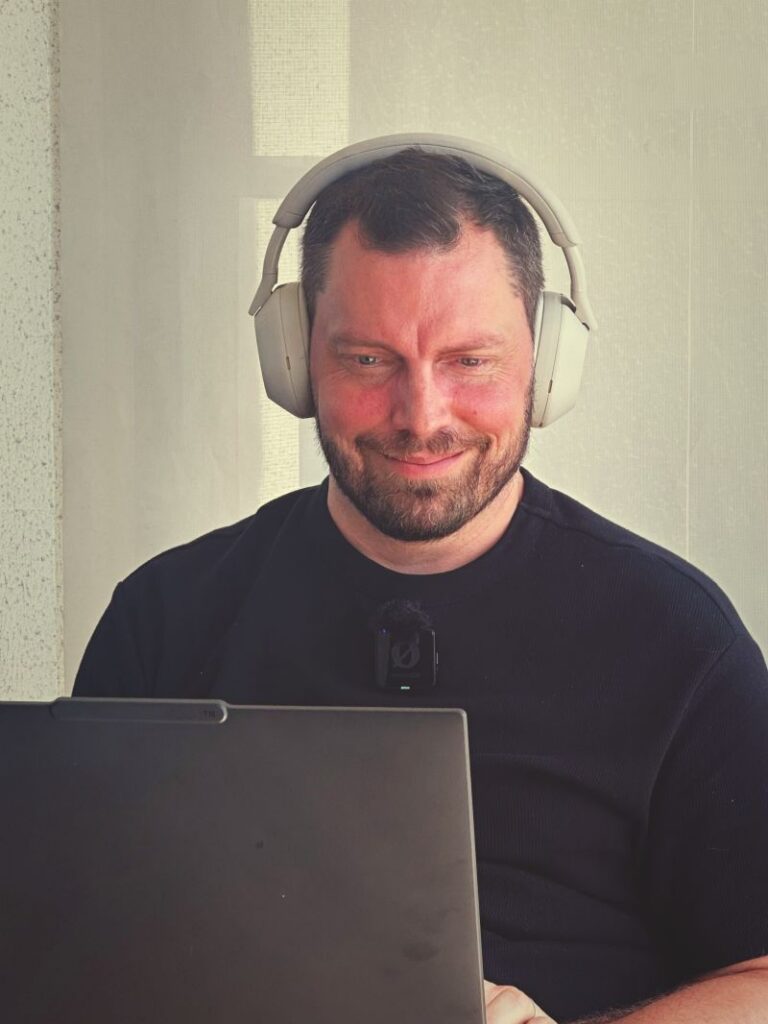
The photo shows the planning of one such collaboration with a management team 🙂